Process mapping
We record what actually happens — not what the handbook says.
We map your workflows, work out for each one what it costs today and what would be left after automation — and hand over a prioritised roadmap. Then you decide whether you build it or we do.
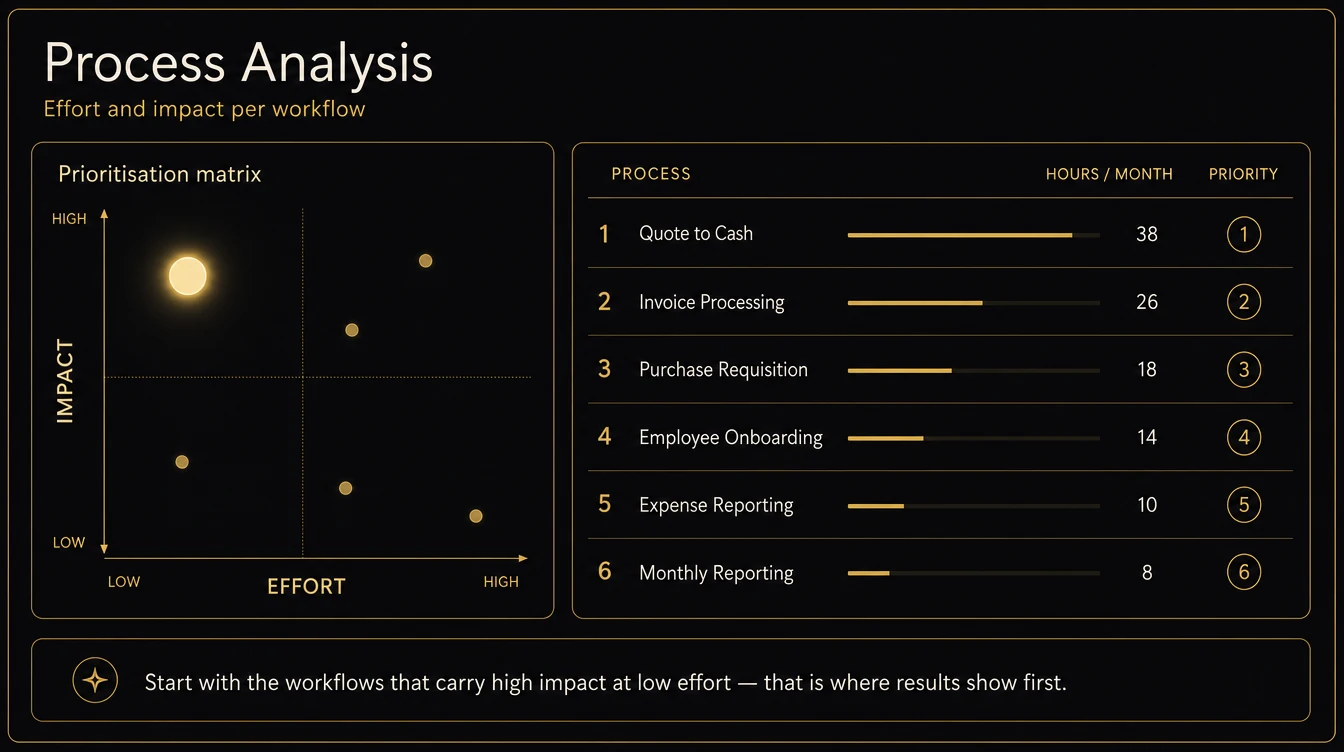
The most common question is not „can this be automated?“ but „where do we start?“ It is a fair question. Almost any workflow can be automated technically. Far from all of them pay off.
So every engagement begins the same way: with a sober map. Who does what, how often, how long it takes, and where somebody waits for somebody else. Every workflow gets two numbers: cost today, cost afterwards. That sets the order.
What you end up with is a roadmap you can work from — including without us. That is deliberate. Consulting that only makes sense if a build follows is not consulting.
We record what actually happens — not what the handbook says.
Every use case gets a number instead of a feeling.
Sequence, effort estimate, and the workflows better left alone.
So AI lands in daily work — safely, and with clear boundaries.
AI projects start with the tool: somebody tries something, it sort of works, and nobody can say what it achieved.
You know what each workflow costs, what automation changes about it, and in which order it is worth doing.
We look at what actually happens — tasks, frequencies, waiting times, handovers.
Cost today, cost afterwards. That sets the order — biggest lever first.
We build, connect your systems and test against real data. It goes live once it holds.
We measure, sharpen and take on the next workflow.
Both begin with mapping your workflows and producing a prioritised roadmap. Then you decide who builds.
We show you the way — your team walks it.
Outcome: you can start without us.
More on consultingWe show you the way — and walk it with you.
Outcome: it runs — accounts and data stay yours.
Request a process checkQuestions on Consulting
Yes, and it is explicitly designed that way. The roadmap is written so your team can start from it — including recommendations on tooling, data flows and sequence.
The first conversation with an initial assessment is free and without obligation. For the analysis itself you then receive a fixed-price quote, scoped by the number of workflows and people involved.
For a bounded area, a handful of sessions with the people who do the work daily is usually enough. A workable roadmap is typically ready within a few weeks.
Then that is what the result says. It is rare, but it happens — and it is a far better outcome than a system nobody uses.
Describe it in two or three sentences. You will get a free, no-obligation assessment: whether and how it can be automated — and roughly what that means.