Sorting & routing
Enquiry, invoice, booking, complaint — every message lands in the right place automatically.
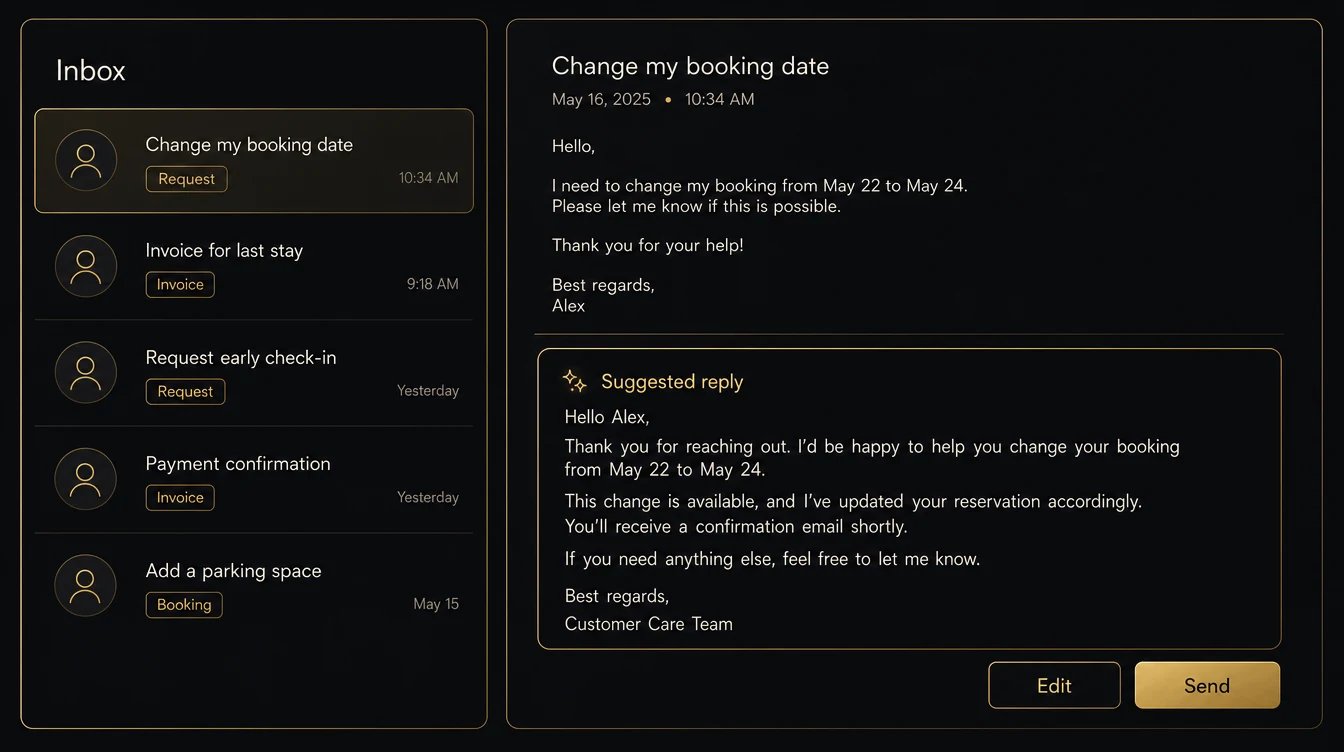
Every incoming message is read, assigned to a topic, routed to the right place and given a suggested reply. Your team decides — instead of triaging.
The expensive part of customer service is not answering. It is the sorting: reading, understanding, assigning, forwarding, finding the reference number, pulling the context together. Only then does the actual work begin.
That run-up is what gets automated. Every message is captured, assigned to a topic, linked to the relevant customer history and routed to the right person — with a suggested reply based on your previous answers and the rules you set.
What your team delivers stays the same: the decision. What falls away is the half hour before it.
Enquiry, invoice, booking, complaint — every message lands in the right place automatically.
A finished draft based on your previous answers — adjust and send.
Whatever is time-critical or delicate is recognised as such and pulled forward.
Cases, orders and customer data are pulled along instead of looked up.
Every message is read, assigned and forwarded before anyone even answers. Urgent cases only surface late.
Messages arrive sorted and with a draft attached. Your team reviews and sends — and can see immediately what comes first.
We look at what actually happens — tasks, frequencies, waiting times, handovers.
Cost today, cost afterwards. That sets the order — biggest lever first.
We build, connect your systems and test against real data. It goes live once it holds.
We measure, sharpen and take on the next workflow.
Both begin with mapping your workflows and producing a prioritised roadmap. Then you decide who builds.
We show you the way — your team walks it.
Outcome: you can start without us.
More on consultingWe show you the way — and walk it with you.
Outcome: it runs — accounts and data stay yours.
Request a process checkQuestions on Customer service & email
Only if you explicitly want that, and only for clearly bounded cases — acknowledgements or plain status updates. The default is a suggestion for approval.
They are flagged as unclear and handed to a person rather than answered badly. That boundary is exactly what we define together beforehand.
With the common systems, yes, through their official interfaces. Changing your mailbox or helpdesk is generally not required.
We establish before launch which data is processed, keep out what is not needed and process within the EU where possible — including the paperwork for your record of processing activities.
Describe it in two or three sentences. You will get a free, no-obligation assessment: whether and how it can be automated — and roughly what that means.